
Solemnity of St. Benedict - 11th July 2025
At Vespers shortly we will hear a reading from Colossians chapter 3, which starts with:
If you have been raised with Christ, seek the things that are above, where Christ is, seated at the right hand of God. Set your minds on things that are above, not on things that are on earth, for you have died, and your life is hidden with Christ in God. [Col 3:1-3]
My mind is very literal and can get fixated on the geography of a passage like this. Where is the ‘above’ where the things I must seek are to be found? Where is God sitting? If our ‘life is hidden with Christ in God’ where does that leave us? Are we to take our leave of this earth and float around somewhere up in the sky in a spiritual haze?
Of course this talk of ‘up’ and ‘down’ is metaphorical. We naturally seem to locate the spiritual world ‘up’, in the realm of the sky where there is light and air and where birds fly free. ‘Down’ is the realm of earth, darkness, decay and heaviness. We are physical, earthly creatures, constrained by bodies that wear out and die but we are animated by a spirit that longs for the freedom of the spiritual realm, to soar up into the sky and fly like a bird.
The Greeks believed that our eternal spirits are temporarily trapped in our physical bodies and that the aim of the spiritual life is to liberate ourselves from this trap. This has left its body-hating mark on the development of the Christian tradition, but in the Hebrew Bible God created human beings from the earth as whole persons and breathed the Spirit of life into them. We are created as persons that have both physical and spiritual dimensions, inseparable from each other. Ultimately this is expressed to the full in the incarnation of God in the person of Jesus Christ. Through his life, death, resurrection and ascension he gathered up human nature into God and opened the way for each one of us to enter into the fullness of the divine life even whilst in this earthly realm. This is not something esoteric – we simply have to be fully who we are. As Irenaeus of Lyons wrote ‘The glory of God is a human being fully alive’1.
I have been struck in Paul’s letters how he intertwines a sublime, cosmic vision with teaching about the nitty-gritty of daily life. We see it in today’s reading when immediately after telling us that our lives are ‘hidden with Christ in God’ Paul goes on to write about all the behaviours that we are to ‘put to death’, indicating that being ‘hidden with Christ in God’ has a whole lot to do with how we live our daily lives. It is firmly rooted in our bodily life here and now, not something ethereal and other-worldly. Paul ends his practical exhortations with the resounding statement that there are no longer any racial, religious or social distinctions but that ‘Christ is all and in all’ – a cosmic spiritual vision that we must take to heart in our earthly lives.
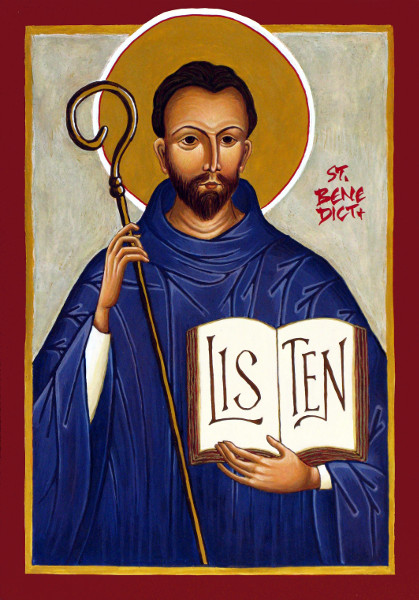
Today we celebrate St Benedict by whose Rule we aspire to live. He points us to a way of life which embodies this awareness that ‘Christ is all and in all’. As we know, he asks us to receive guests as Christ, acknowledging Christ’s presence in all people, whether they be rich or poor, holy or disreputable. He asks us to treat the vessels of the kitchen as if they were vessels of the altar – after all, if ‘Christ is all and in all’ then that means pots and pans as well as other people. It also means all the plants and animals in the environment around us. Our whole lives are to be shot through with a sense of Christ’s presence as a kind of fourth dimension to whatever we encounter – Christ is not lurking in a spiritual realm elsewhere.
To return to Paul, tomorrow morning at Lauds we hear the continuation of the passage from Colossians chapter 3:
As God's chosen ones, holy and beloved, clothe yourselves with compassion, kindness, humility, meekness, and patience. [Col 3:12]
These are surely the things ‘above’ that we are to seek, lived out in the humble experience of our daily lives.
Mother Anne - 10th July 2025 (This reflection was shared with the community before 1st Vespers of the Solemnity of St Benedict)
1 Irenaeus of Lyons, Against Heresies: 4.20.7 (2nd Century)